The Connective Nature of Tonal Harmony
Consider the following sentence:
“I’m going to the harpsichord.”
If you didn’t speak any English, you wouldn’t have a clue what word could go there. Every word in the dictionary would be a candidate.
But we do speak English, and we understand the rules of grammar. This allows us to narrow down the possibilities. We know that a verb must go there. Not only that, but the context allows us to narrow it down even further. We know it can’t be “eat” or “throw.”
This is exactly how tonal harmony works. Tonal harmony is actually very simple, once you grasp the rules of the grammar of harmony. Chords do not exist in a vacuum: they relate to the chords that come before, and the chords that follow. Key area provides us with further context. Tonal harmony is connective, and you’ll find that given any chord in a certain key, only a few chords can possibly follow it.
This is why most historical figured bass parts have few to no figures. Everyone just knew what chord was needed.
Definitions
Figure:
A numeral (or set of numerals) above a bass note that refers to an interval (or intervals) above that bass note.
Full Figure:
Figured bass is full of abbreviations. The “Full Figure” refers to the complete, unabbreviated figure. For example, the full figure of a 6 chord is 6/3.
RH Position:
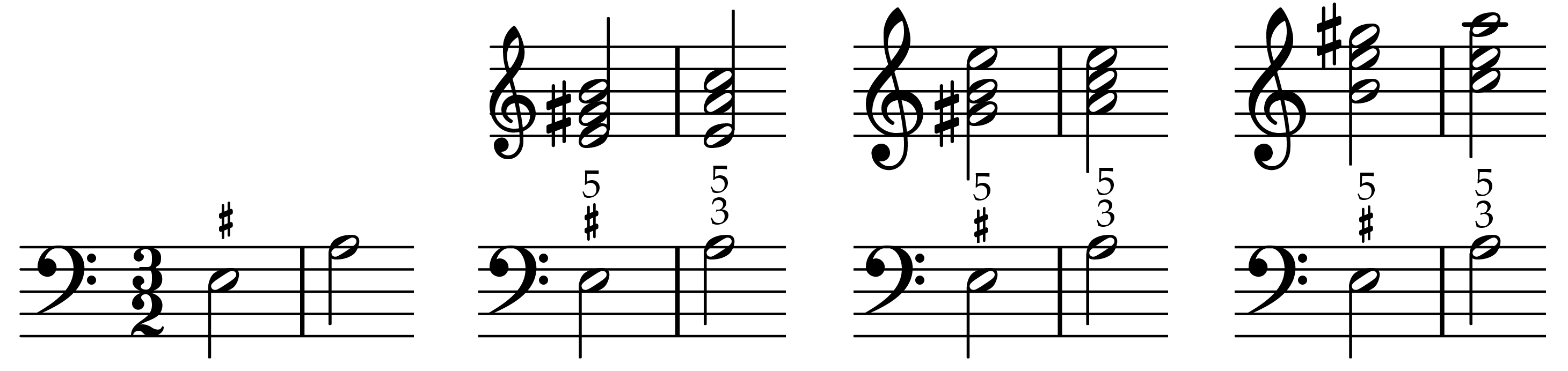
"Position" refers to the arrangement of the RH chord. In the example below, the chord described by the figures can be played with the following positions:
There are other ways to play the RH chord, of course: you could add or subtract doublings. It is often tempting for beginners to think of the RH position as "inversion. This is a mistake and will only confuse you.
Cadence
A cadence is a harmonic stopping point. For the purposes of this class, we will only consider three main kinds of cadences:
a Closed (or Full) Cadence sounds like an ending: in Theory class we call them “V-I” or “vii-I”.
a Open (or Half) Cadence often sounds like another phrase is needed: in Theory class we say they end on a V chord.
a Deceptive (or Evaded) Cadence substitutes an unexpected chord for the final chord so it doesn’t sound like an ending: in Theory class we call them “V-vi”.
A cadence usually has the following qualities:
The last note of the cadence is on a strong beat
The last note of the cadence has no dissonance in it
The last note of the cadence is not preparing a suspension
The last note sounds somewhat final, like a comma or period in a sentence.